Friday, 28 December 2012
Why is the piece of cardboard you put in the end of a joint called a roach?
In 1836 Texas was an independant country, and was at war with Mexico. Mexico then owned much of what today is part of the USA, California for example. This is the reason why so many places in that part of America have Spanish names: Los Angeles, San Fransisco, etc.
The 1836 war is famous for the Battle of the Alamo where a handful of Texan patriots, including the likes of Dave Crockett and Daniel Boone, were besieged in a small mission station by a vastly superior Mexican force, and eventually slaughtered to the last man. This led to the USA joining the war against Mexico, Texas becoming part of the US, and Mexico losing a good deal of its territory to the States.
The Battle of the Alamo is much more famous in the States than over here; and arouses the sort of emotion that historical events like the Black Hole of Calcutta* used to arouse in this country before, for rather obvious reasons, we had to stop talking about that all sort of thing.
The Mexican General at the Alamo was called Santana, and it's a very commonly said that "at the Alamo Santana's men were all high on marijuana". It's a way of explaining the reckless courage and ferocity displayed at the final assault by the otherwise notably unenthusiastic Mexican soldiers.
To be fair, marijuana use in the Mexican army at the Alamo was probably no greater than in the Mexican army at any other point in the nineteenth century. That is to say pretty near universal, in the lower ranks at least. Life in any army of that period was likely to be nasty, brutish and short. But the one concession allowed the enlisted (or conscripted) soldier was a liberal supply of whatever cheap and socially acceptable intoxicant was around. In Europe, it was alcohol; in Mexico, cannabis.
A favourite Mexican army marching song from the time of the Alamo contains the following verse:-
La Cucaracha, la Cucaracha
Se no puede caminar;
Perque no tiene, perque no tiene
Maria-Juana por fumar.
(Lit: The cockroach, the cockroach he can't walk around; because he hasn't got, because he hasn't got marijuana to smoke).
The Texans picked up on this song (it's quite catchy, it's to the 'Speedy Gonzales'-type tune that everyone thinks of when they think of Mexican music) and by association cannabis cigarettes became known as 'roaches'.
The Yanks roll joints a bit different to us (or at least they used to): they roll neat grass in single skins, adding neither baccy nor a rolled up bit of cardboard at the gob end. Instead they used to use miniature tong type things called 'roach clips' so that you could smoke the very last bit of your Acapulco Gold or whatever without burning your fingers.
I'm speculating here, but it seems logical that at some point, prob in the 1960's, a Brit and a Yank sat down to smoke a bit of dope and the elegant metal clip holding the American's tiny neat weed single-skinner was seen to be performing the same function as the rolled up bit of Rizla packet jammed in to one end of the Brit's tarry Rothman-and-three-skins contraption. As the bit of Rizla obviously isn't a clip, and the 'roach clip' obviously is; by a process of elision the bit of cardboard became known as 'the roach', in this country at least.
Incidentally the Mexican term 'Gringo' as a perjorative epithet for Americans comes from the same period. A favourite American marching song was "Green Grow The Rushes-oh!", from which the Mexicans took the word immortalised in a thousand crap westerns: "Hey, Greengo! We come to keeeell you!"
* Never heard of it, have you? Shame on you!

Monday, 17 December 2012
Puss In Boots
You probably know the plot: Dick Whittington, poor boy from the country, goes to London to seek his fortune. Finds the street aren't paved with gold. Discouraged, he sets off to return to the farm but is called back by the city's bells which chime "Turn again Whittington, thrice Lord Mayor of London". With the help of the eponymously-shod feline, he makes his pile and is duly elected LM of L three times.
Richard Whittington was a historical character, a merchant in the late middle ages who made his fortune in the cloth trade with Flanders. He was indeed Lord mayor of London a number of times, although he probably had four cracks at Boris Johnson's current job rather than three. So not a bad transmission of an accurate, if obscure, historical fact via a popular dramatic medium. But why the introduction of the improbable anthropomorphised character of the pantomime title?
At the time, the Dutch used a type of sailing vessel which was of a shallow enough draft to navigate Holland's canals, but was also seaworthy enough to make the choppy channel crossing. These boats were called 'poezen'. The Dutch word for boat is 'boot'. So, how did Dick Whittington make his fortune? With Poezen Boots!
Ta-daa! Next up: Ghengis Khan's trousers.
Sunday, 11 November 2012
Hawkwind are advertising cars on the telly. Again. This time the Ford B-Max is being dangled in front of your eyes to the strains of 'Master Of The Universe' from Hawkwind's second album, the seminal 'X In Search of Space' (1971).
I suppose I shouldn't be surprised. 'Silver Machine' (actually about Bob Calvert's racing bike) was used a couple of years ago for a Volkswagen commercial. But the choice the Ford advertising execs made this time struck me as a little, well, poignant.
'Masters of the Universe' is a Hawkwind standard: a choppy three chord riff that starts, stops, starts again and then builds up to a crescendo before.......well, stopping and starting up again. It's actually pretty easy to play: I could teach you the bass line in 5 minutes. But, like practically any Hawkwind song, its the version that makes all the difference.
You could have taken the Live '79 version, which is basically a heavy metal song with Dave Brock doing his "awright cockney geezah" vocal interpretation. You could have had the Space Ritual Live version from 1972:- operatic in scale, with Lemmy pounding away on bass, but a bit acoustically foggy as its a live album. And any one of a dozen other versions; bootleg, official, and everything in between.
But they chose the "...In Search of Space" version. That's my favourite Hawkwind album, that is. All the songs on it, like all Hawkwind songs, are about space travel, or travel to other dimensions, or taking LSD. Sometimes its hard to work out exactly which one of the three themes is being referenced in any given song. But don't worry, the Hawks themselves probably weren't too clear on the distinctions at the time either.
It's a lovely album. It came in a fold-out sleeve, gorgeously decorated inside and out with photos of the band and psychedelic artwork. Just right for pinning to your bedsit wall to cover the patch were the previous occupant, Mad Alkie Jimmy, had tried to headbutt his way through to next door. He also used to save his wee in milk bottles. Moving day was an eye-opener, I can tell you. There was a booklet included with the album, the Ship's Log of Spaceship Hawkwind; words by Calvert and Moorcock, and more artwork by Barney Bubbles. Musically the album is probably as close to Hawkwind's sound during their early free festival period as you're ever going to get. Turner's honking away on his sax through a wah-wah pedal, Dikmik and Detmar are proving the swooshes and bleeps on the audio generators, Brock weighs in with some lovely 12-string work and Hawkwind's best ever drummer, Terry Ollis, is pounding away like a loon. It's quirky, and as English as Punch and Judy.
Little known Hawkfact: "X in Search of Space" was the reason I didn't revise very hard for my O-Levels. Me, Paul and Andy were going to squat a house in Wootton, get a band together* and, basically, never have to get up before midday ever again. Good thing we didn't go down that road, isn't it, Hawkwind? Turns out all everybody wants in their twilight years is a nice gaff, a decent income stream, and plenty of leisure time; and I can't see that Ford would have now been playing any of OUR songs and thinking "Hey, we could really use this track to promote the new Ford X-Lax".
Edgar Broughton will be next, you mark my words. On his blog he's mithering about not being able to get a packet of decent dried shitake mushrooms. How the mighty are fallen, plaster saints, feet of clay, etc etc. Yes, I'm a big boy now, and I understand how the world works. All my own fault I'm not a heart surgeon/CEO of Microsoft/presenter on Strictly Ballroom, I know. But I really listened to people like the Hawks and the Broughtons. The whole anti-materialist thing, you know. All you need is a greatcoat, a bottle of patchouli, and an eighth of leb. A seductive message when you're a spotty 15 year old 'erbert from the brussels sprout fields of rural mid-Bedfordshire. But, as we've seen, a deeply flawed one as well. So, before he turns up on the telly advertising Cillit Bang or Vagisil, here's Edgar and his bro's while he still had balls.
http://www.youtube.com/watch?v=FOKoYWDJpvc
* We didn't get the squat, but we did get a band together. We were actually pretty good: a blatant Hawkwind/Sex Pistols cross-over. We had two front men, a guy with a blue beard and blue hair who played the sax, and a bloke who used to sing from inside a child's inflatable space capsule, plus the usual bass/guitar/drums. At one point we even picked up a female dancer. Every gig ended with the front row of the audience being deluged in a variety of semi-liquid substances: pig's blood and rehydrated dried dog food, e.g.
Of course, that got a mixed reception in mid-1970's Bedfordshire. Some people loved us, some people (the straights, maaan!) would give us a good kicking. We even provoked the wrath of a Beds on Sunday columnist, Jim Raybould, who entitled one article "Bedfordshire's Most Hated Band!" The exclamation mark is Jim's, not mine. And not least, leaving each venue a quagmire of congealing unpleasantness meant that we ran out of pubs and clubs willing to host us, there not being very many to start with.
As these things do, the band broke up. But for a while there, and given a break, I reckon we might have made it to some degree, perhaps on the festival circuit or in Germany. But we didn't and we went our separate ways. The guy with the blue beard shaved it off and surprised everybody by joining the RAF and retiring as a sergeant. One of the guys who used to do a bit of guitar died of a methadone overdose. And the rest of us somewhere in between, I guess.
But I can still remember some of the lyrics and some of the chords from the songs we did. C-E minor-D-dah-dee-dah-dee-dah-dee-dah:- that's 'The Alien Song', that is. "I was king of this planet for all of you to see, till that bloody fat willy started picking on me, now my dreams are shattered and it makes me want to pee. I could rule this world if it wasn't for that thing called Dibdohhhhh................" A lot of detail from that period in my life has faded: faces,places and names become monochrome and jumbled. I suppose a lot of the pubs have gone now, people moved on. But, by George, put a geetar in my hand this very second and I could still whack out 'Dibdo Lands on the Porridge Planet' ("....the Porridgeman thinks he is a prannet. His ray can kill Dibdo, or can it? Cos Dibdo's body is made of granite"). Probably best if I don't though, as Mrs W is having a nice nap on the sofa, so forgive me.
We were a genuine musical phenomenon though, albeit in a small way and for a brief while. The cops were called to shut down the Leighton Buzzard leisure centre gig. I think that this is probably the first time that we've ever been mentioned on the net though, so ephemeral and fleeting is fame. Please allow me, with pride, to give our name here for the first time:- Dibdo Gibbs and the Prophets of Delirium.
Friday, 25 May 2012
Endlosung
"The government has decided to dissolve the people,
and elect another."
-Bertolt Brecht, 'The Solution',1953
Here Brecht is satirising the events of the uprising in Soviet-controlled Hungary, when the mask of spurious democracy slipped for a brief second, and the whole political machinary of the 'Democratic Soviet Socialist Republics' (bogus elections, listed canditates, 98% per cent 'yes' votes and so on) was exposed as the Socialist imposition of tyranny against the genuine wishes of the people.
In this poem Brecht imagines how a regime could cease to rely on all those annoying and fiddly trappings of a faux-democracy, simply by somehow reconstituting the actual subject population into one which is far less able to be an impediment to eternal Socialist dictatorship.
Wow. Awesome!
Wednesday, 29 February 2012
Kathleen Raine: she died a couple of years ago at a ripe old. In the 60's she was briefly married to Gavin Maxwell during one of his denial phases, and a line from Kathleen's poems provided the title for his famous book 'Ring of Bright Water'.
Her pomes iz wikkid, innit? A wilful luminous Classicism ensured she'd never be a contender against the likes of spiteful Phillip Larkin, or the unspeakable Andrew Motion. She died not unlamented but largely unrecognised.
The only prob is that it can be difficult not to hear her as being read by Penelope Keith in full Margot Ledbetter mode. Some of it can get a bit, well, 'overwrought'. Thank you, Kathleen, that was lovely. Now sit down and have cup of tea, dear.
Still, its all good stuff, and got me out of more than one tight spot on quiz nights with the Erdington Chapter of The League of St George. Here's to ye, Kate. In Elysium's fields may ye dwell:-
"Who dreams these isles,
Image bright in eyes
Where waves beat upon rock, or rock-face smiles
Winter and summer, storm or fair.
In eyes of eider clear under ever-moving ripples the dart
and tremor of life;
Bent-grass and wind-dried heather is a curlew's thought,
Gull gazes into being white and shell-strewn sands "
--- Eilleann Chanaidh, by Kathleen Raines.
Monday, 27 February 2012

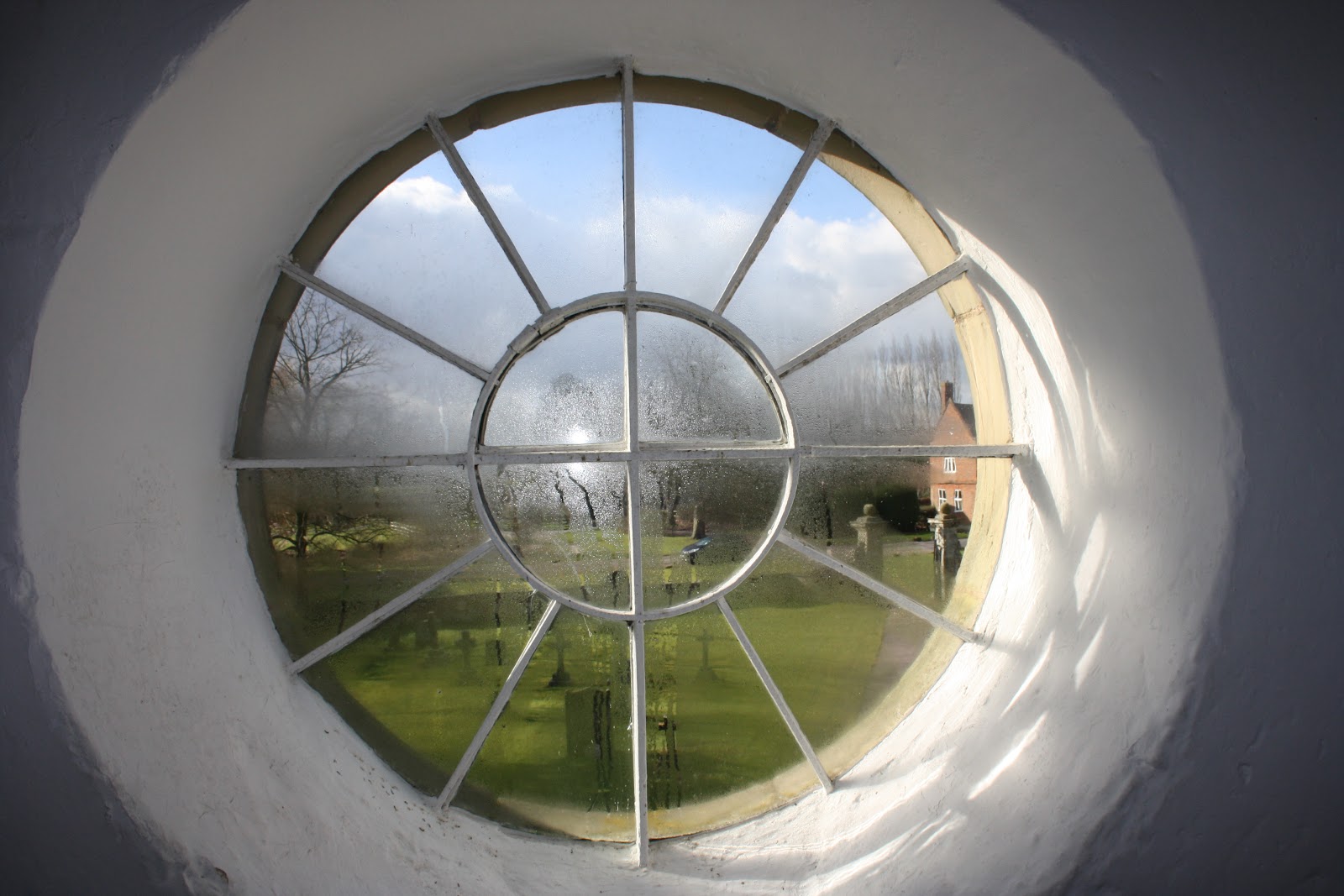


Honiley Church. An elderly Sir Christopher Wren bought the neighbouring manor of Wroxall in 1700. He became friends with the squire of Honiley and, when asked at dinner to design a new church for the parish, sketched the design on a napkin at the dinner table. C18 churches are rare in this country, most ecclesiastical work from this period involves the updating of existing church fabric, although St pauls church in Brum is about the same vintage.
The old church of Honiley may have had a shrine attached: there exists a doubtful fifteenth century charter exempting the parish from church taxes and which mentions a holy well, and separate bathing areas for men and women. Nothing seems to remain today, although a spring rises in the field behind the church.
The house in the last picture is 100 yards or so from the church, and was probably a tied farm built around the same time as the church. The triangular dormer window is unusual.
Subscribe to:
Posts (Atom)